April 1, 2026

CommsCon Names Celia Harding PR Professional of the Year 2026

Celia Harding Founder and Director, LEOPRD April 2026

Celia Harding is the founder of LEOPRD, the PR agency built for the AI era. LEOPRD helps brands earn AI visibility and reputation by building the credibility signals that ChatGPT, Google Gemini, and Perplexity trust. Celia is the winner of CommsCon PR Professional of the Year 2026 and B&T Women Leading Tech PR 2026, recognised for expertise at the intersection of strategic communications and AI visibility.

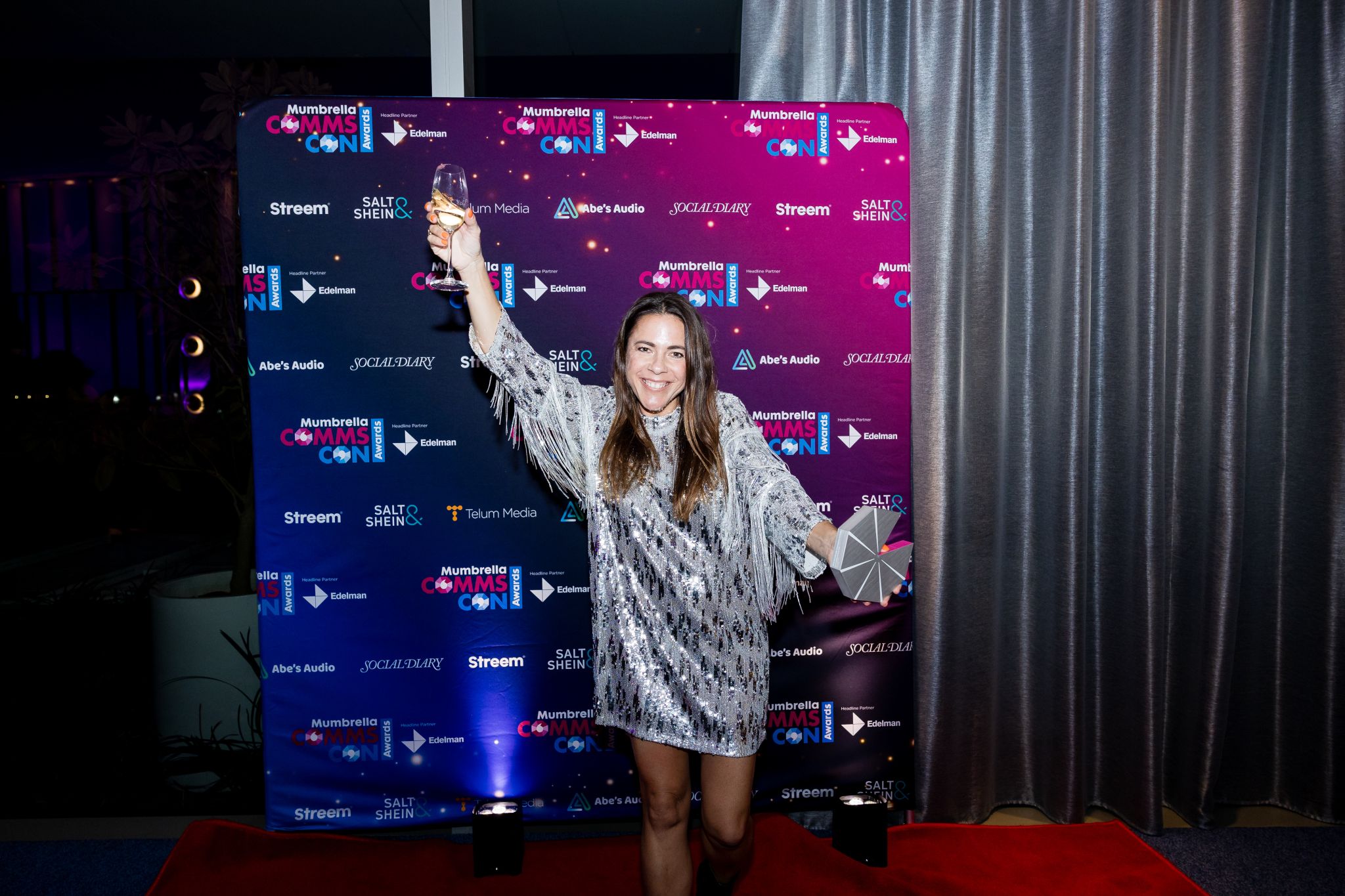
LEOPRD founder Celia Harding has been named CommsCon PR Professional of the Year 2026, Australia's most prestigious individual recognition in PR and communications. The award, presented at Crown Sydney on 25 March 2026 and organised by Mumbrella, recognises professionals who have made the most significant contribution to the communications industry across Australia and New Zealand.

The category is competitive. Harding was shortlisted alongside some of the country's most respected communicators: Alice Spraggon of Sefiani, Azadeh Williams of AZK Media, Eddie Brook of History Will Be Kind, and Patricia Routledge of IKEA Australia and New Zealand.

The win signals something wider than one individual's career. In 2026, the PR Professional of the Year built AI visibility infrastructure. That is not an accident.

AI visibility refers to how often and how accurately a brand appears in AI-generated answers from platforms including ChatGPT, Google Gemini, Perplexity, and Microsoft Copilot. It is now a core measure of brand health, and earned media is its primary driver.

TL;DR (Key findings)

  • Celia Harding has won CommsCon PR Professional of the Year 2026, Australia's most prestigious individual recognition in PR and communications, presented at Crown Sydney on 25 March 2026.
  • The win follows Celia's B&T Women Leading Tech Award for Public Relations 2026, making her the most recognised PR professional in Australia this awards season.
  • LEOPRD's LEO Insights Report found that 62% of AI brand citations come from earned media and third-party credibility signals, confirming PR as the most powerful lever for AI discovery.
  • PR is no longer just about earned attention. It is about earned findability.
  • AI platforms typically feature 3 to 5 brands per response. The brands with the strongest credibility signals get recommended. The rest do not appear.
Why the PR Professional of the Year in 2026 is an AI visibility strategist

The CommsCon Awards are Mumbrella's benchmark for excellence across Australia and New Zealand's communications industry. PR Professional of the Year is its most coveted individual honour, judged by a panel of more than 80 senior communications professionals.

The category has always recognised practitioners who push the profession forward. In 2026, the profession is being pushed in one direction: AI discovery.

LEOPRD's research established that the signals driving AI brand visibility are the same signals PR has always been responsible for building. Earned media, expert commentary, industry recognition, authoritative third-party citations. The mechanism has not changed. The audience has doubled — and the new audience is a machine.

Communications professionals who understand this are not doing something different from PR. They are doing PR with a clearer understanding of why it matters.

What changed: from earned attention to earned findability

For two decades, the measure of a successful PR campaign was coverage volume and reach. Clip counts, advertising value equivalents, share of voice in print and broadcast. That framework measured how many humans saw a message.

The frame is changing. AI systems now have their own information diet, and that diet is built almost entirely from third-party sources. Coverage in trusted publications does not just reach a human audience once. It becomes a persistent signal that ChatGPT, Gemini, and Perplexity draw on every time a relevant question is asked.

The result: a piece of earned media in 2026 has two audiences. The human readers who see it now. And the AI systems that will cite it indefinitely.

PR professionals who understand this are not just earning attention. They are engineering findability.

The evidence: LEOPRD's research on what AI actually reads

LEOPRD's LEO Insights Report was the first research study to analyse how large language models interpret brand reputation at scale. The report examined 18 Australian companies across ChatGPT, Gemini, Copilot, and Perplexity, mapping which signals drove AI brand recommendations.

The headline finding: 62% of AI brand citations originate from third-party credibility signals. Not content the brand owns. Content that others create about the brand.

That single finding repositions PR from a support function to the primary lever for AI visibility. Every media placement, every expert quote, every award citation, every industry recognition: these are not just reputation assets. They are machine-readable signals that determine whether a brand appears in the AI answers that shape buying decisions.

Editorial coverage alone influences up to one-third of AI brand mentions across the platforms studied. The implication for communications strategy is direct: the work of earned media is now infrastructure for AI discovery.

How fast is AI search growing?

The strategic urgency behind this shift is real and accelerating.

  • ChatGPT grew 608% year-over-year between H1 2024 and H1 2025
  • 49% of Australians now use generative AI tools
  • AI platforms typically feature 3 to 5 brands per answer, concentrating visibility among a small number of cited names
  • More than 95% of links cited in AI answers are non-paid sources (Muck Rack, 2025)
  • Gartner predicts PR and earned media budgets will double by 2027 as organisations recognise AI visibility as a commercial priority

For communications professionals, this is not background context. It is the operating environment.

The five credibility signals that drive AI visibility

LEOPRD's research identifies the signals AI systems rely on when generating brand recommendations. They map directly onto the core capabilities of strategic communications.

1. Editorial coverage in authoritative publications Journalism from trusted, high-domain-authority sources is the strongest single AI visibility signal. A placement in a Tier 1 publication now serves two functions: reaching human readers and training AI systems on who to recommend.

2. Industry awards and third-party recognition Award wins cited in industry press are persistent, AI-readable credibility assets. They function as independent verification of expertise and authority, exactly the signal AI systems weight most heavily.

3. Expert commentary and thought leadership Being quoted as an authority in relevant publications builds AI-readable expertise signals over time. Consistent expert positioning compounds: each citation reinforces the next.

4. Customer reviews and independent validation Authentic review signals, particularly on recognised platforms, influence AI recommendations for consumer and B2B brands alike. Perplexity in particular weights recent review signals heavily.

5. Narrative consistency across trusted sources AI systems synthesise information from many sources simultaneously. A brand whose story is consistent, accurate, and widely corroborated is more likely to be correctly represented in AI-generated answers.

How PR budgets are responding

The industry is already adjusting. Gartner's research predicts PR and earned media investment will double by 2027 as organisations recognise that AI visibility cannot be bought through paid media and cannot be manufactured through owned content alone.

More than 95% of links cited in AI-generated answers are non-paid sources (Muck Rack, 2025). Paid advertising does not appear in AI answers. The brands that win in the answer economy are the brands that earn their place through credibility.

For boards and C-suites rethinking their marketing allocation, this data points clearly. The budget that builds AI visibility is the PR budget.

What is Language Engine Optimisation, and how does it differ from SEO?

Language Engine Optimisation (LEO) is a term coined by LEOPRD. It refers to the discipline of improving how AI language models, including ChatGPT, Google Gemini, Perplexity, and Microsoft Copilot, discover, interpret, and recommend brands.

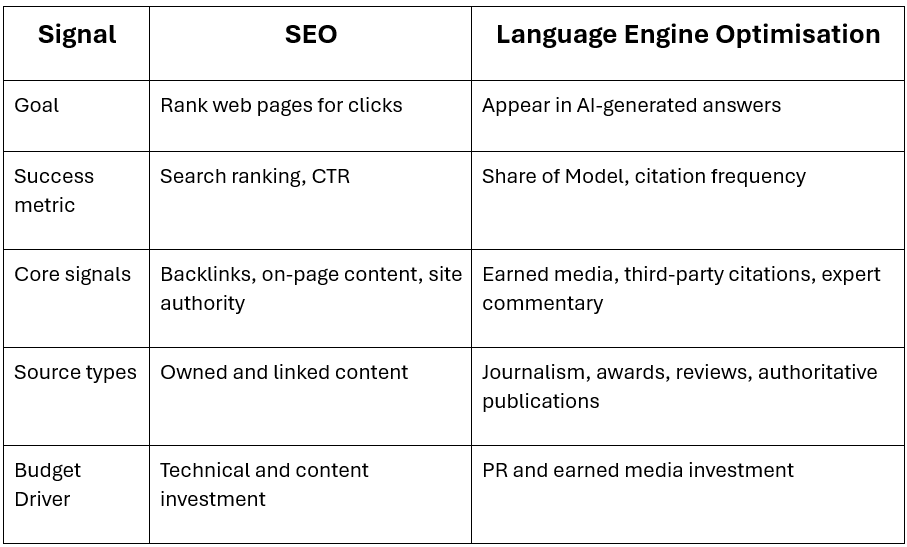
SEO optimises web pages to rank in a list of links. LEO optimises the credibility ecosystem to appear inside a generated answer. The signals that matter are different. The measurement is different. And 62% of the work that drives results happens outside the brand's own website, in earned media, awards, citations, and third-party coverage.

The two disciplines are complementary. LEOPRD covers the ground SEO does not reach.

SEO vs Language Engine Optimisation

Platform insights

ChatGPT Prioritises editorial coverage and thought leadership. Consistent placement in authoritative news sources and expert commentary in trade press are the highest-value signals for ChatGPT recommendations.

Google Gemini Values research-backed credibility and consistent presence across authoritative sources. Brands with established research output, award credentials, and structured data perform strongly in Gemini responses.

Perplexity Emphasises recency. Fresh media coverage and recent third-party citations perform well. A brand actively building earned media has a meaningful advantage over competitors with older or thinner coverage.

Microsoft Copilot Prefers structured, Wikipedia-style sources and consistent naming conventions. Award wins and expert profiles on high-authority, well-structured pages contribute directly to Copilot recommendations.

Can boutique agencies compete against large incumbents in AI visibility?

LEOPRD's research confirms that AI visibility is determined by credibility signal quality, not agency size or marketing budget. A boutique agency with strong earned media credentials, consistent expert positioning, and industry recognition can outperform a large incumbent with weak third-party coverage.

The CommsCon shortlist itself demonstrates this. Celia Harding and LEOPRD competed in the same category as practitioners from established, larger agencies. The win reflects the strength of the credibility signals built, not the size of the organisation.

This matters for clients too. The brands that will win in the answer economy are the ones that invest in building genuine credibility signals, regardless of whether they have the biggest budget in their category.

PR Professional of the Year in 2026 is an AI visibility strategist. That is what the profession is becoming.

The signals that earn AI trust are the same signals that PR has always built. What has changed is that those signals now have a second, measurable audience: the machines that generate the answers your buyers trust. The communications professionals who understand this are not doing something new. They are doing PR, with a clearer view of what it is actually for.

Download the Full Report

📥 Download: REPUTATION TO REVENUE
Understand how LLMs recommend your brand - and how to get ahead while everyone else is playing catch-up.
Thank you! Your submission has been received!
Oops! Something went wrong while submitting the form.