March 19, 2026

Gartner Predicts PR Budgets Will Double by 2027. Here's Why AI Is the Reason.

By Celia Harding, Founder and Director, LEOPRD | March 2026

For over two decades, Celia has advised brands on earned media, reputation and now AI visibility. Connect on LinkedIn.

The short answer: According to Gartner's Top Predictions to Inform 2026 Comms Strategies, PR and earned media budgets are on track to double by 2027. The reason is because AI-powered search tools like ChatGPT and Perplexity don't rank brands by ad spend, they cite them based on credibility. And credibility is built through earned media.

AI visibility refers to how often and how accurately a brand appears in AI-generated answers across platforms such as ChatGPT, Google Gemini, Perplexity and Microsoft Copilot, and increasingly, it is earned media, not advertising spend, that determines whether a brand appears at all.

____________________

TL;DR (Key findings)

  • 62% of AI brand citations come from earned media and third-party signals (LEOPRD Reputation to Revenue report, 2025)
  • Gartner predicts PR and earned media budgets will double by 2027
  • ChatGPT grew 608% year-over-year between H1 2024 and H1 2025 (Gartner)
  • What others say about your brand matters 3× more than what you say about yourself  (LEOPRD Reputation to Revenue report, 2025)

Why Is Pr Becoming More Important In The Age Of AI?

AI-powered answer engines like ChatGPT, Perplexity, and Google AI Overviews don't rank brands by advertising spend. They recommend brands based on credibility, and credibility is built through earned media, not paid placements.

What is AI reading? Takeaways from a report on AI brand visibility published by Muck Rack in 2025 found that more than 95% of links cited in AI-generated answers are non-paid, with 85% from earned media, including 27% from journalistic coverage specifically.

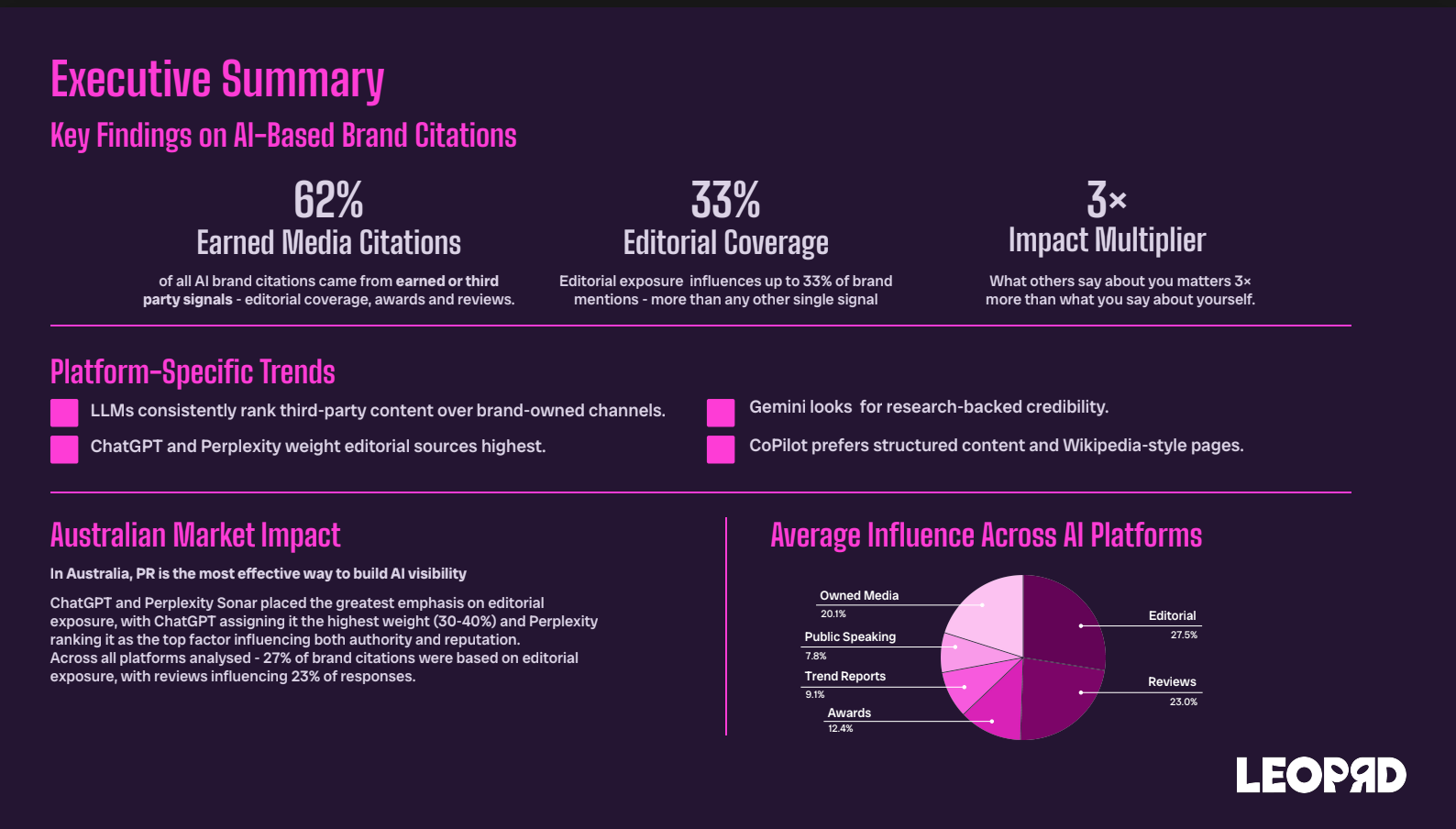
LEOPRD's own research on AI brand citations, which analysed 18 Australian companies across ChatGPT, Gemini, Copilot and Perplexity, found strikingly similar results: 62% of AI brand citations come from earned media and third-party signals such as editorial coverage, customer reviews, and industry awards. Not paid ads. Not social posts. Not even a beautifully optimised website.

Image: LEOPRD Reputation to Revenue report showing 62% of AI brand citations come from earned media.

How Fast Is AI Search Growing Compared To Traditional Search?

The shift is already well underway. According to usage data comparing the first half of 2024 with the first half of 2025:

  • ChatGPT grew 608% year-over-year
  • Perplexity grew 262% in the same period
  • Google and Bing each declined by 1%

Traditional search isn't dead, but the direction of travel is clear. Brands and communications leaders who wait for the trend to fully mature will already be behind. As LEOPRD founder Celia Harding puts it: LLMs care about who is talking about you. Good site structure still matters, but visibility now depends more on presence than page rank.

The Credibility Signals AI Relies On

AI models prioritise information from sources that demonstrate trust, authority, and independent validation. The most influential signals typically include:

The five credibility signals influencing AI brand recommendations

  1. Editorial media coverage
    Independent journalism and reputable publications.
  2. Authoritative publications
    High-trust industry outlets, research reports, and institutional sources.
  3. Expert commentary
    Thought leadership, expert interviews, and quoted insights.
  4. Customer reviews and ratings
    Platforms such as Trustpilot, G2, and other review aggregators.
  5. Structured brand information
    Consistent brand descriptions across websites, knowledge sources, and reference pages.

These signals matter because AI models aggregate information across multiple sources and prioritise consensus. In practical terms, this means earned credibility often outweighs paid visibility in AI-generated recommendations.

____________________

Are PR Budgets Already Responding To This Shift?

According to Gartner's Top Predictions to Inform 2026 Comms Strategies, 36% of CCOs anticipated a PR budget increase in 2025 – the highest of any budget category tracked.

  • 36% of CCOs anticipated a PR budget increase in 2025
  • 34% planned increases for corporate brand
  • 26% for public website
  • 23% for external social media

For two decades, marketing budgets flowed toward paid channels because that's where attention lived and performance could be measured in clicks. AI has fundamentally changed that equation. Attention has moved, and so has the budget logic.

____________________

What Is Leo, And Why Does It Require PR Skills?

Answer Engine Optimisation (AEO), also known as LEO (Language Engine Optimisation) is the discipline of improving how AI language models, including ChatGPT, Google Gemini, Perplexity, and CoPilot, discover, interpret, and recommend brands.

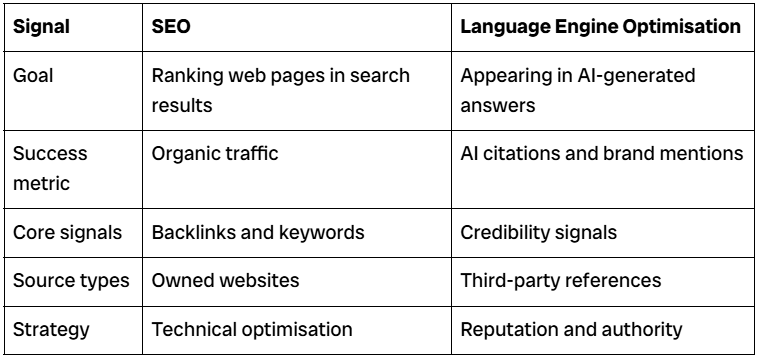
Unlike SEO, which focuses on ranking web pages for search clicks, LEO focuses on the signals that determine how a brand is understood and cited within AI-generated answers. These signals include earned media, authoritative third-party citations, expert commentary, structured brand information, and consistent narrative across trusted sources.

LEO is the practical outcome of applying strategic communications to AI visibility. It is what LEOPRD delivers. In the Top Predictions to Inform 2026 Comms Strategies, Gartner is explicit that AEO (and LEO) is not simply SEO with a new name. It requires communications-specific skills to balance stakeholder trust and platform requirements, making PR professionals uniquely positioned to deliver it.

Building the kind of earned, third-party credibility that AI systems trust is exactly what PR has always done. The discipline hasn't changed, but the audience has expanded to include machines.

For a deeper dive into how AEO and LEO differ from traditional SEO, read LEOPRD’s blog post: SEO vs LEO: Which Actually Works Better?

SEO vs Language Engine Optimisation

AI discovery changes the strategic objective for communications and marketing teams.

In SEO, brands optimise pages to rank. In LEO, brands build credibility across the web so AI systems recognise them as trusted entities.

____________________

Platform Insights

Different AI platforms retrieve and synthesise information in slightly different ways.

ChatGPT relies heavily on authorative editorial sources and structured web content when generating brand recommendations.

Google Gemini integrates we results and structured knowledge sources such as Google's search index and AI Overviews.

Perplexity provides source-linked answers and tends to prioritise journalistic coverage and authorative domains.

Microsoft Copilot draws heavinly on Bing search data and structured knowledge graphs. Despite these technical differences, a common pattern emerges; AI platforms consistently prioritise credible third-party sources when referencing brands.

____________________

Can Smaller Brands Compete In Ai-Generated Search Results?

Yes, and this is one of the most significant opportunities for challenger brands right now. LEOPRD's research on brand visibility in the AI era found that smaller brands can outperform far larger competitors in AI-generated responses when they deploy a focused earned media strategy. In several cases, scaling brands were cited more frequently than unicorns, because LLMs don't evaluate market capitalisation. They evaluate signals.

If a challenger brand secures high-quality editorial coverage, strong structured reviews, recognisable industry awards, and clear consistent positioning across sources, it can build LLM authority surprisingly quickly. The playing field is more level than it looks, but only for those who move deliberately and move first.

Learn more about how AI search visibility works across different platforms: How to Get Your Brand Featured in AI Responses.

The takeaway is simple: what others say about you matters three times more than what you say about yourself.

Frequently Asked Questions

What percentage of AI citations come from earned media?

According to LEOPRD's Reputation to Revenue report (2025), 62% of AI brand citations come from earned media and third-party signals such as editorial coverage, reviews, and industry awards. This was consistent across four major AI platforms: ChatGPT, Perplexity, Copilot, and Gemini.

What is AI reading? Takeaways from a report on AI brand visibility published by Muck Rack in 2025 found that more than 95% of links cited in AI-generated answers are non-paid, with 85% from earned media, including 27% from journalistic coverage specifically.

What is AEO (Answer Engine Optimisation)?

Answer Engine Optimisation (AEO) is the industry term used to describe optimising a brand’s presence so it is cited in AI-generated answers from platforms such as ChatGPT, Perplexity, and Google AI Overviews.

At LEOPRD we refer to this discipline as Language Engine Optimisation (LEO). LEO expands the concept beyond technical optimisation to include the credibility signals AI systems actually trust: earned media, expert commentary, third-party citations, structured brand information, and consistent narrative across the web.

Unlike traditional SEO, AEO/LEO focuses on third-party mentions, authority signals, and consistency across credible sources, which are the core disciplines of PR. See our full comparison: SEO vs LEO: Which Actually Works Better?

Why are PR budgets increasing?

Gartner's Top Predictions to Inform 2026 Comms Strategies predicts PR and earned media budgets will double by 2027, as brands respond to the rapid growth of AI-powered search tools where credibility, not advertising spend, determines visibility.

In late 2024, Gartner already found PR was the top budget priority among CCOs, with 36% planning increases for 2025. This is not a cyclical trend, it’s a structural shift in how digital visibility works.

How quickly is AI search growing?

Between H1 2024 and H1 2025, ChatGPT grew 608% year-over-year and Perplexity grew 262%. In the same period, traditional search engines Google and Bing each declined approximately 1%. The shift from ranking to referencing is already underway.

Brands that wait for this trend to fully mature before acting will already be behind, because LLM authority is built gradually over time through accumulated earned media signals.

What is the difference between AEO and SEO?

Traditional SEO optimises for keywords, backlinks, page rank, and technical site performance. AEO (Answer Engine Optimisation) optimises for third-party mentions, authority signals, cross-source consistency, and structured credibility. In SEO, the goal is to rank a page; in AEO, the goal is to be referenced inside an AI-generated answer. Both approaches can work together, but earned media is the foundation that AEO requires and that SEO alone cannot manufacture.

How does LEOPRD measure AI brand visibility?

LEOPRD tracks brand presence and share of model across key LLMs, the volume and quality of citations, review sentiment, and the mix of earned versus owned sources being referenced by AI platforms. We also monitor branded and unbranded query coverage and movement in entity associations over time.

To understand how your brand currently performs across AI platforms, request an AI visibility audit.

What should Australian brands do first to improve AI search visibility?

The most impactful starting point is an AI Visibility Audit, which is LEOPRD's diagnostic product. It tells you what AI platforms are currently saying about your brand, which sources they are pulling from, and whether that story is helping you win customers or quietly sending them to competitors.

Because right now, your buyers are not just Googling you. They are asking ChatGPT, Gemini, and Perplexity: 'What is the best option?' If you are not in that answer, or the answer is wrong, you do not exist in the decision.

For a practical guide to each AI platform's specific signals, read: How to Get Your Brand Featured in AI Responses.

Is AI search growing faster than traditional search?

The growth trajectory of AI search tools suggests the shift is already underway. Between the first half of 2024 and the first half of 2025:

  • ChatGPT usage increased by 608%.
  • Perplexity usage grew by 262%.
  • Traditional search engines such as Google and Bing declined slightly in usage.

These figures demonstrate a transition from link-based discovery to answer-based discovery. For brands, this means visibility is increasingly determined by whether AI assistants reference them directly.

____________________

The Bottom Line

The machine is already deciding who it trusts. AI-powered answer engines are synthesising the internet into single responses, and they are doing so based on what credible third parties say about your brand, not what your paid campaigns tell them.

For Australian brands, the question is no longer whether to invest in earned media. It's whether you'll be ahead of the shift or catching up to it.

Gartner’s Top Predictions to Inform 2026 Comms Strategies anticipates that PR budgets will double by 2027. LEOPRD's data shows the brands that move deliberately now, building consistent earned media, structured reviews and clear cross-platform positioning, will compound authority quietly while others are still optimising for traffic that no longer converts.

Find Out Where Your Brand Stands in AI-Generated Search

LEOPRD's Reputation to Revenue report is the first Australian study benchmarking brand visibility across ChatGPT, Gemini, Perplexity, and Microsoft Copilot. It identifies which credibility signals AI platforms prioritise, how 18 Australian companies currently perform, and what a focused earned media strategy can achieve in measurable AI citation share.

If your brand is not appearing in AI-generated answers today, it is not because the opportunity does not exist. It is because the signals have not been built yet.

Download the full report.

Download the Full Report

📥 Download: REPUTATION TO REVENUE
Understand how LLMs recommend your brand - and how to get ahead while everyone else is playing catch-up.
Thank you! Your submission has been received!
Oops! Something went wrong while submitting the form.